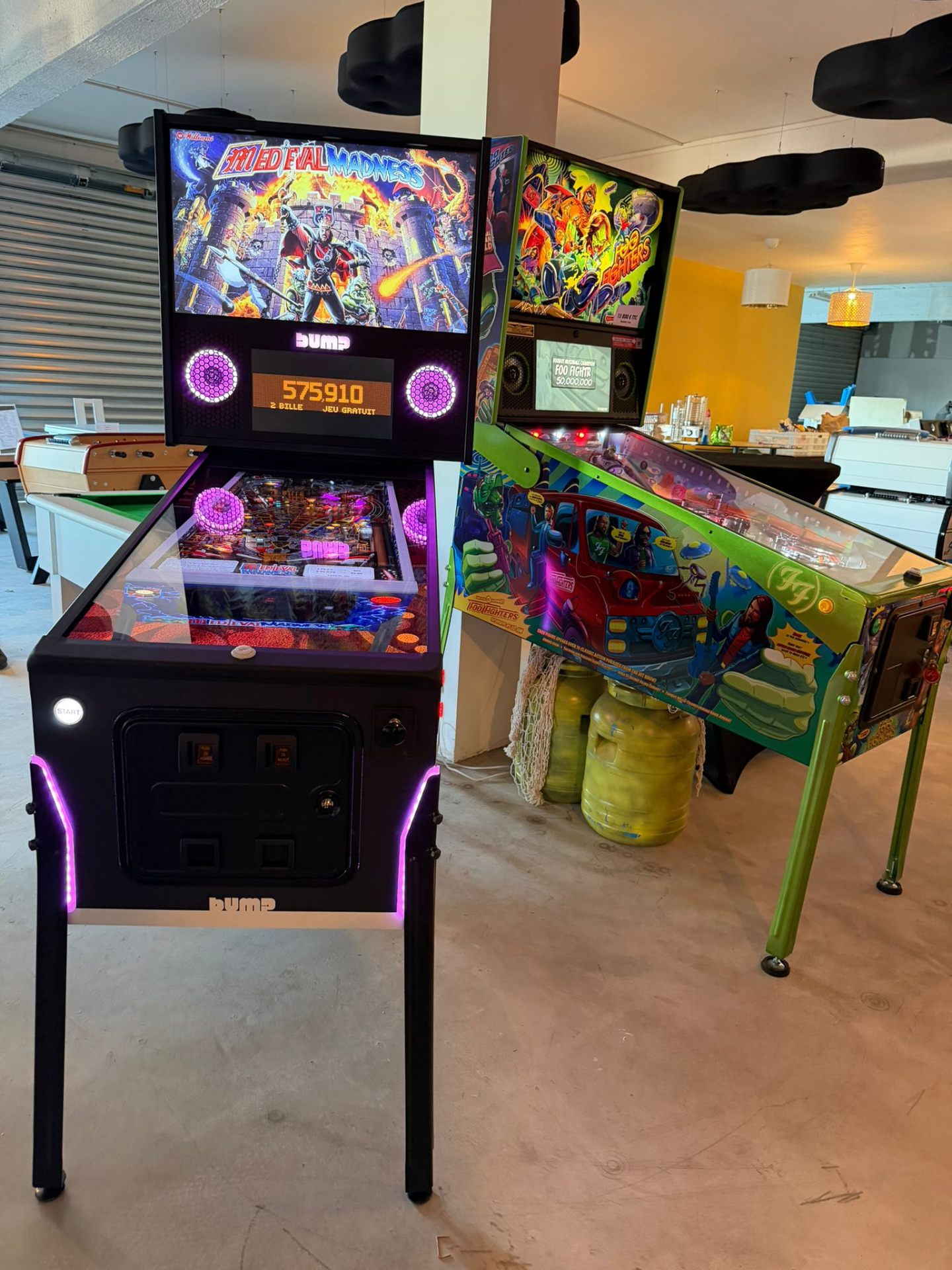
Guide —
Mechanical pinball vs virtual pinball: which type for which player?
The title "mechanical pinball VS virtual pinball" sounds like a fight. It's a false debate. There's no winner between the two worlds because they don't compete on the same ground. A Williams™ Twilight Zone™ from 1993 maintained by the book is far superior to a buggy entry-level pincab. Conversely, a Bump PRO RTX 5070 powered by Pinball FX™ from Zen Studios™ (official licensed publisher for Williams™, Bally™, Stern™ and Marvel™) outperforms a basic 1970s Gottlieb™ that needs constant servicing. The real question isn't "mechanical or digital?" but "which type of pinball matches your profile, budget, space and playing philosophy?". This guide breaks the myth of the mechanical vs virtual pinball battle and takes you into what really matters: brand, ruleset quality, component quality, maintenance cost and fit with your actual use.
No opposition, just different typologies
For years, the pinball debate has been framed as a simplistic binary: "mechanical is authentic, digital is the future". That frame is wrong. The 2026 reality is that two parallel universes coexist, each with excellent and downright mediocre machines. Comparing the top of one universe to the bottom of the other makes no sense, yet that's exactly what most mechanical vs virtual pinball articles do.
An excellent mechanical pinball typically looks like a 1992 Williams™ Medieval Madness™ in original condition, with a deep ruleset, an immersive theme, a waxed playfield and spare parts still readily available. A mediocre mechanical pinball looks like a poorly maintained 1970s Gottlieb™ with a minimalist ruleset, broken parts that are nearly impossible to source and a restoration cost that quickly exceeds the machine's value.
On the digital side, an excellent virtual pinball is something like a Bump PRO OLED 2026: optimized code, input latency under 30 ms, shaker and gear motor, stable software, regular updates. A mediocre virtual pinball, by contrast, is an entry-level €2,000 pincab with an Intel GPU, 150 ms+ latency, buggy code and a low-end LCD screen that kills the immersion within the first ball.
The pivot point for any serious choice isn't technology, it's the triptych brand quality + ruleset quality + component quality. That trio is what separates an excellent mechanical pinball from a poor one, and an excellent pincab from a poor one — far more than any mechanical vs virtual pinball opposition.
Before choosing: the real questions to ask yourself
Before comparing two machines, ask the right questions. They structure the decision better than any raw spec sheet and prevent the impulse buy you'll regret six months later.
- What's your true all-in budget? A €3,000 and a €10,000 budget don't open the same doors: include purchase, shipping, annual maintenance and eventual resale depreciation.
- How much space do you really have? A 4 m² living room imposes very different constraints than a 20 m² bar — width, depth, clearance, acoustics, ambient light, maintenance access.
- What's your maintenance skill level? Are you happy swapping rubbers, soldering boards and rebuilding flipper assemblies, or do you want a machine that just needs a power plug and a software update?
- Are you in love with a specific table (Medieval Madness™, Twilight Zone™) or do you want variety so you never get bored?
- What's your player philosophy? Pure mechanical authenticity, modern technology without compromise, or a hybrid balance between both worlds?
Mechanical pinball: brand quality is everything
In the mechanical pinball world, brand and era determine nearly everything. Williams™ (golden age 1990–2000), Gottlieb™ (1960–1980 peak), Stern™ (modern continuation since 2000), Bally™ and Data East™ don't build the same experience. A manufacturer means a specific ruleset, a design philosophy, a parts-availability dynamic and a resale trajectory. Ignore the brand dimension and you'll regret it.
What does an excellent mechanical pinball look like?
- An iconic Williams™ or Stern™ reference — Medieval Madness™, Twilight Zone™, Addams Family™, Attack from Mars™ — with 8+ modes, branching sequences and proper multiplayer.
- Exemplary condition: annually waxed playfield, recent flippers, working bumpers, recent rubbers, original or specialist-restored electronics.
- A healthy secondary market: spare parts at specialist resellers, active community forums, stable resale value.
- Coherent 5-year cost: €12,000–14,000 purchase for a properly restored Medieval Madness™, €1,500 cumulative maintenance, resale around €9,000 (iconic Williams™ hold their value well). Real cost of ownership about €5,000–6,500 over the period.
What does a mediocre mechanical pinball look like?
- A basic 1970s Gottlieb™ or an entry-level Bally™, with worn playfield and minimal ruleset (2–3 targets, few modes, fast game over).
- Rare spare parts, sometimes impossible to find, with maintenance costs easily passing €800 a year at a specialist.
- Unbalanced 5-year cost: €2,000 purchase + €4,000 maintenance, resale capped at €500. Real cost near €5,500 for a machine less enjoyable than a more expensive Williams™.
Verdict: an excellent Williams™ beats a mediocre Gottlieb™ on every axis — playing pleasure, heritage value, cost of ownership, ease of maintenance. Before pitting mechanical against virtual pinball, first make the right choice WITHIN the mechanical world.
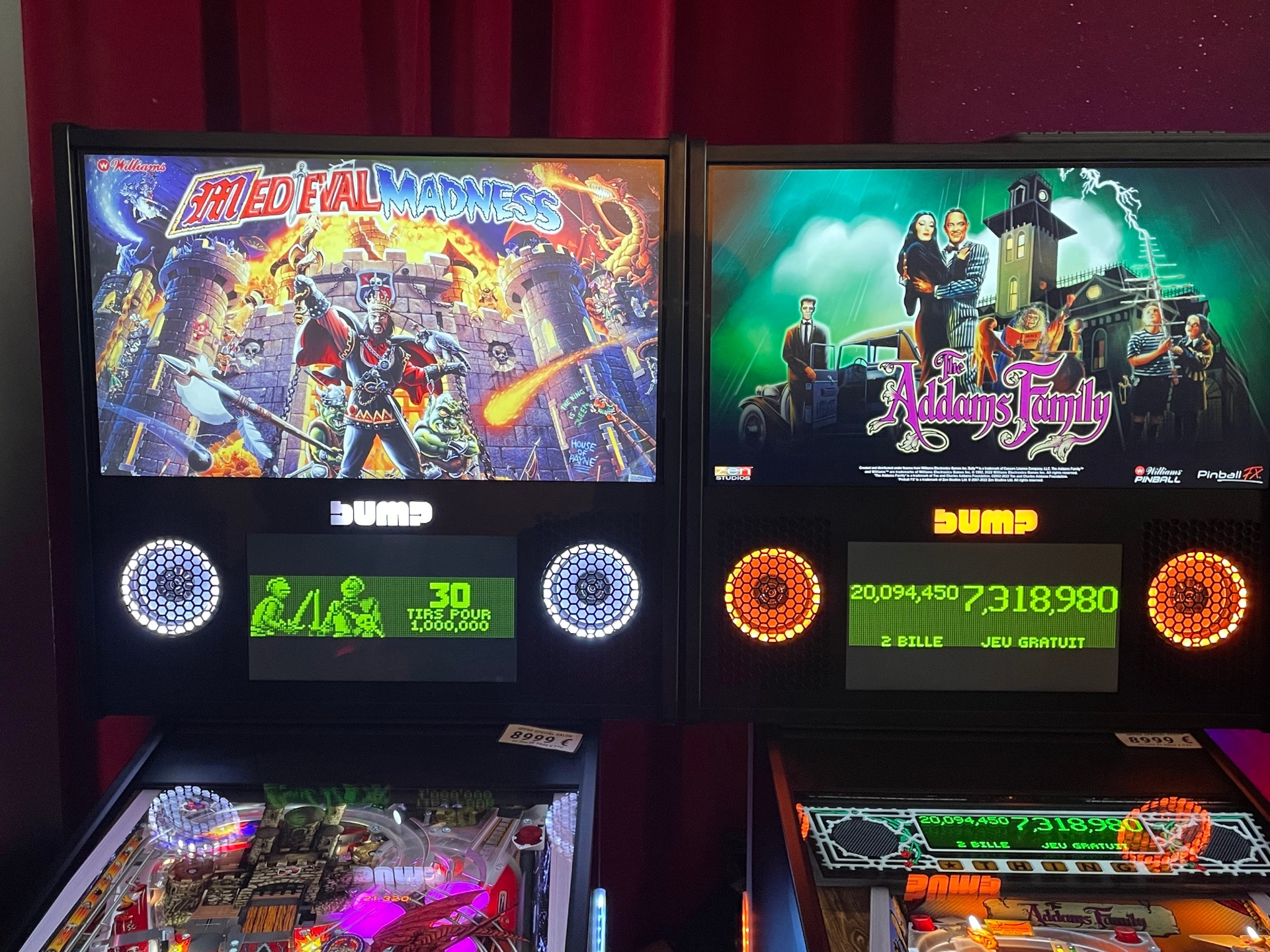
Virtual pinball: components and code, that's everything
The pincab is not a uniform category, and this is probably the most misunderstood point of the mechanical vs virtual pinball debate. Between a €2,000 entry-level pincab and a €9,990 high-end one, the gap is comparable to that between a rental car and a German premium sedan. The GPU changes everything. Code quality changes everything. Latency changes everything. The screen changes everything.
What does an excellent virtual pinball look like?
- A 2026 Bump PRO OLED, assembled in France, with shaker, gear motor and programmable RGB LEDs, and measured input latency under 30 ms — a feel very close to a mechanical pinball for most players.
- A 43-inch 4K OLED screen delivering pure blacks, fluid animations and contrast that turns every table into a visual spectacle, whereas a low-end LCD crushes the detail.
- The Pinball FX™ engine from Zen Studios™, fully optimized, with access to 140 official Williams™, Bally™, Stern™ and Marvel™ / Star Wars™ tables, chosen and bought individually for €2–€10 per table, plus free updates that regularly add new tables.
- Tight 5-year cost: €9,990 inc. VAT purchase, around €500 electricity = €10,490 total spend. Resale around €1,500 (15%), real cost of ownership about €8,990.
What does a mediocre virtual pinball look like?
- A €2,000 entry-level pincab with a non-dedicated Intel GPU, 150–200 ms input latency that makes skill shots impossible and instantly betrays the virtual nature of the machine.
- A low-end LCD with washed-out colors, no shaker or gear motor, none of the physical sensations that make pinball pinball.
- Frozen code built on unmaintained amateur builds or abandoned open-source community engines, with a practical lifespan of 3–4 years before software obsolescence.
- Misleading 5-year cost: €2,000 purchase + €2,500 electricity (inefficient GPU) + €1,000 GPU replacement = €5,500 for an experience that will remain frustrating at best.
Verdict: an excellent pincab beats a mediocre pincab on every front, but it's not therefore "better" than an excellent mechanical pinball. It's a choice, not a hierarchy. To dig into what separates a real high-end pincab from a hastily assembled cabinet, read our guide on what truly defines a high-end pincab.
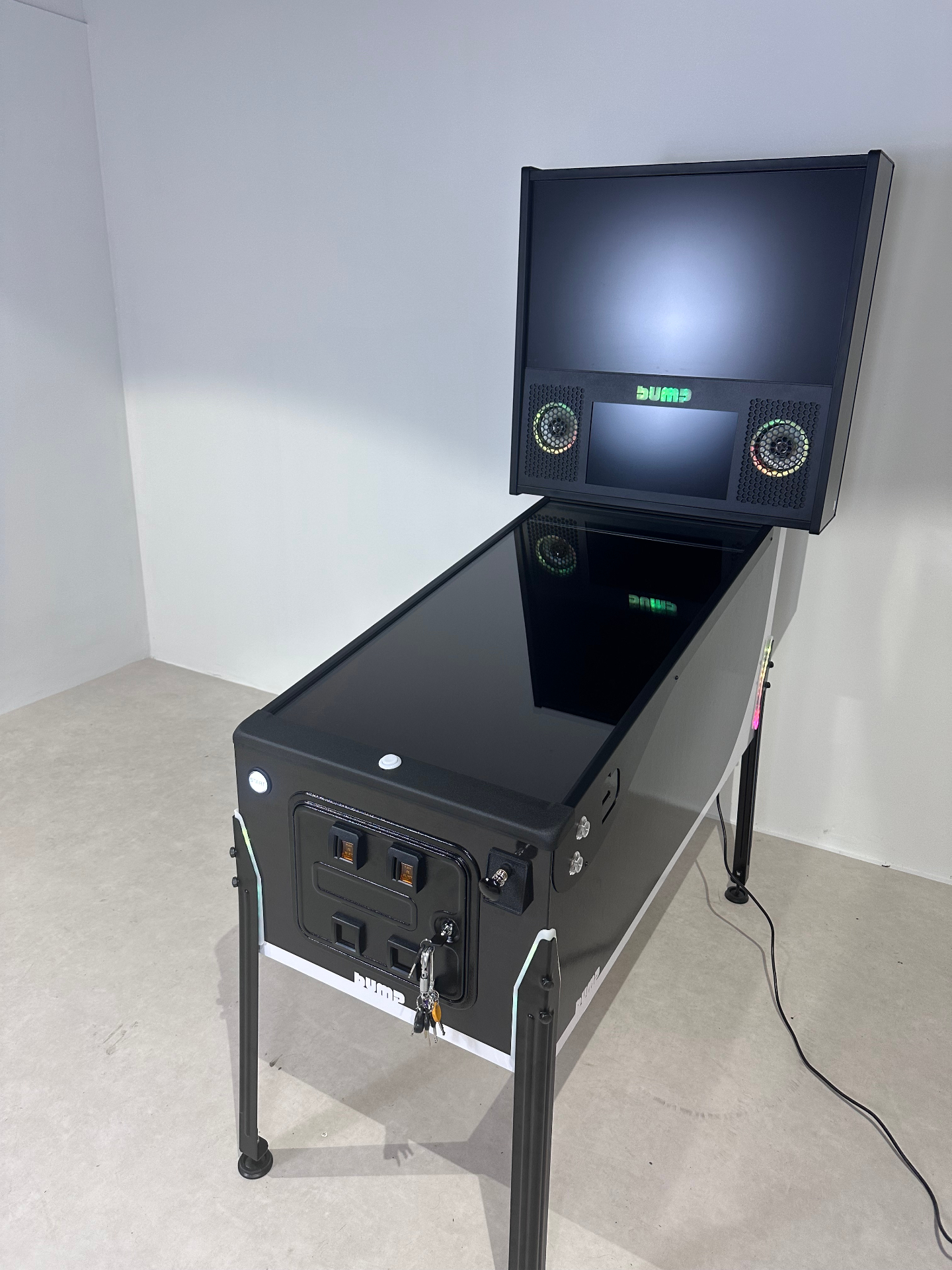
Gameplay: mechanical theme vs coded ruleset
This is probably the most interesting battlefield in the mechanical vs virtual pinball comparison. On a mechanical machine, the rules are largely encoded in the physics itself: target layout, ramp angles, bumper strength. As a result, the ruleset is intentionally contained, typically 3 to 8 modes, with immediate accessibility that defines the genre. But theme quality varies enormously by era and manufacturer: Medieval Madness™ (1992) offers a deep ruleset with its castle to destroy and 7 main modes, while a basic Gottlieb™ may have just 2 targets and a single objective.
On a virtual pinball, rules live in the software, which unlocks possibilities impossible in mechanics: a modern digital version of a classic table can pack 80+ modes, full storytelling, cinematic sequences and multi-tier multiball. The flip side, on pincabs assembled from community engines, is that code quality depends entirely on volunteers — a well-ported table outperforms the original, a sloppy port ruins the session. On the Bump PRO, that risk disappears: Pinball FX™ is developed in-house by Zen Studios™, who guarantee the quality of every ruleset and the consistency of the physics engine across the entire catalog.
Gameplay verdict: an exceptional Williams™ theme always beats a basic Gottlieb™ theme, and well-coded digital beats buggy digital. Universe (mechanical or digital) is secondary to the quality of the theme itself. This is exactly why the mechanical vs virtual pinball debate is poorly framed.
Immersion: physical sensation vs high-fidelity animation
Immersion is the number-one argument for mechanical defenders: you can't digitally reproduce the weight of a 27-gram steel ball bouncing off a bumper. That's true in the absolute, but it deserves to be qualified for 2026 high-end pincabs. A Bump PRO with 4K OLED, a powerful shaker, a gear motor, synced RGB LEDs and sub-30 ms latency delivers 85–95% of the mechanical sensation for most players, including seasoned competitors.
- An excellent pincab like Bump PRO, with measured 25 ms latency and a powerful shaker, gets very close to mechanical feel without 100% matching it.
- A mediocre pincab with 150 ms latency and no shaker delivers disappointing immersion that constantly reminds you you're playing on a screen.
- A poorly maintained mechanical pinball (tired rubbers, soft flippers, dirty playfield) ruins immersion entirely, even though it's technically "authentic".
- An exceptional mechanical pinball in original condition (a properly restored Medieval Madness™) delivers pure, unfiltered immersion that alone justifies the investment.
Immersion verdict: it depends infinitely more on the CONDITION of the machine and the quality of the COMPONENTS than on the mechanical vs digital universe. A well-tuned Bump PRO crushes a poorly maintained Williams™ on feel, and vice versa.
Maintenance: mechanical vs digital, just different
Maintenance is one of the most distorted topics of the mechanical vs virtual pinball debate. On the mechanical side, count €250 to €800 a year (wax, rubbers, bulbs, springs, flipper adjustments) for 30 to 50 years of durability on the right brands. Williams™ and Stern™ benefit from a vibrant parts ecosystem; 1970s Gottlieb™ and Bally™ become much harder to source for. On the digital side, maintenance is near zero (dust, ventilation, software updates) but electronic durability is around 5 to 10 years before GPU or OS obsolescence.
Total cost of ownership over 10 years
- Excellent mechanical pinball (Williams™ Medieval Madness™ properly restored): €13,000 purchase + €3,000 maintenance = €16,000 spent. Resale around €8,500. Real net cost about €7,500.
- Mediocre mechanical pinball (Gottlieb™ with patchy maintenance): €1,500 purchase + €7,000 repairs = €8,500 spent. Resale €300. Real net cost about €8,200 for a frustrating machine.
- Excellent pincab (Bump PRO RTX 5070 OLED): €9,990 purchase + €1,000 electricity and maintenance = €10,990 spent. Resale around €1,500. Real net cost about €9,490.
- Mediocre pincab: €2,000 purchase + €1,000 electricity + €800 GPU replacement = €3,800. Resale near zero. Real net cost about €3,700 for a machine unusable after 4–5 years.
Cost verdict: the total bill depends far more on INITIAL QUALITY and MAINTENANCE rigor than on the mechanical/digital choice. An excellent restored Williams™ (€7,500 net over 10 years) is mathematically comparable to a Bump PRO (€9,490 net) — but these two machines don't substitute for each other, they complement.
Who should choose what? Player profiles
An excellent mechanical pinball suits
- Authentic collectors who know the heritage value of great Williams™ and Stern™ machines and can spot an original from a re-issue.
- WPT and tournament competitors who need a real ball and imposed physics to train seriously.
- Nostalgia lovers with maintenance skills, comfortable swapping rubbers and diagnosing a board without panicking.
- Budgets between €8,000 and €18,000 depending on tier (Pro, Premium or LE/CE new, restored Williams™ second-hand), ready to accept annual maintenance in exchange for a machine that will last 30+ years.
An excellent virtual pinball suits
- Demanding tech enthusiasts who want OLED, an RTX GPU and sub-50 ms latency without compromise on code quality.
- Families looking to offer 140 official tables available, chosen and bought individually (approx. €2–10 each)to their kids and friends, with zero mechanical maintenance.
- Bars and restaurants that want to maximize variety while bringing maintenance to zero — a French-assembled high-end pincab like Bump PRO handles intensive use without complaint.
- Budgets around €9,990 incl. VAT for an outright purchase, or a long-term lease reserved for professionals at €299 excl. VAT per month over 36 months. Bump provides access to 140 official tables available, chosen and bought individually for €2–€10 per table.
A hybrid setup is worth considering: pairing an excellent mechanical (e.g. a restored Medieval Madness™) with an excellent pincab (Bump PRO) for a total around €22,000–24,000 unlocks the best of both worlds — mechanical authenticity for collector sessions, digital variety for nights with friends.
Brands and philosophies worth knowing
On the mechanical side
- Williams™ (1990–2000): best value-to-longevity on the market, deep rulesets, parts still largely available, stable resale.
- Stern™ (since 2000): modern continuation of the Williams™ philosophy, strong licenses (Star Wars™, Game of Thrones™, Metallica™), active distribution network.
- Gottlieb™ (1960–1980): authentic vintage charm reserved for hardcore collectors ready to chase parts on forums and call specialist restorers.
- Bally™ and Data East™: highly variable quality, evaluate model by model.
On the virtual side
- Bump (RTX 5070, 4K OLED, assembled in France, 2026): French high-end pincab, premium components, racing-grade latency, fine-tuned code, 2-year warranty.
- Other RTX pincabs (European and American builders): broadly correct quality, less software fine-tuning, after-sales support often harder to reach in France.
- Entry-level pincabs (Intel GPU, LCD, no shaker): avoid as soon as your budget allows, otherwise you'll resell the machine within months.
FAQ: mechanical vs virtual pinball
Is an excellent mechanical pinball superior to an excellent pincab in terms of feel?
No, there's no hierarchy. A mechanical pinball offers 100% physical tactility with the steel ball, while an RTX pincab with a shaker and gear motor delivers 85–95% of that tactility plus 100% software variety. It's not a "better" question, it's a player-profile question: raw authenticity on one side, high-fidelity versatility on the other.
What's the minimum budget to avoid mistakes?
For a mechanical pinball, two markets coexist: on the restored second-hand market, expect €12,000–14,000 for an iconic Williams™ (Medieval Madness™, Twilight Zone™, Addams Family™); for a brand-new modern machine, pricing depends on tier — around €8,000–10,000 for a Stern™ Pro, €12,000–14,000 for Premium (Stern™ Premium, Jersey Jack™), €15,000–18,000+ for LE/CE or Limited Edition (Stern™ LE, JJP CE, American Pinball collector). For a virtual pinball, expect €9,990 inc. VAT for an excellent Bump PRO 2026 with 140 official tables available, chosen and bought individually for €2–€10 per table. The main rule: an excellent machine at any price beats a mediocre one bought cheap. The mediocre costs more long-term and always disappoints.
Are 140 tables on a pincab better than a single mechanical table?
Common misconception. A single exceptional mechanical table like Medieval Madness™ or Twilight Zone™ easily delivers 50 hours of discoveries before you've seen it all. Conversely, 140 mediocre tables become boring within a few sessions. Quantity never replaces quality — what matters is the quality of each table, not the count.
Which type of pinball for a bar or restaurant?
An excellent high-end pincab is usually the most relevant choice for a professional venue: 140 official tables available, chosen and bought individually (approx. €2–10 each), zero mechanical maintenance, ability to switch between family-friendly tables during the day and more adult tables at night. The hybrid setup (1 pincab + 1 iconic mechanical) remains the optimum for venues that want to stand out lastingly.
What's the real lifespan of a mechanical pinball vs a virtual pinball?
A well-maintained mechanical pinball easily lasts 30 to 50 years. A high-end pincab lasts 5 to 10 years before the GPU or OS becomes outdated, but remains repairable with a new graphics card. This lifespan gap isn't a decisive criterion: it's offset by near-zero maintenance.
Which type for a child or a family?
For a family with kids, an excellent pincab like the Bump PRO is often more relevant: no fragile parts to break, table selection per age, regular updates, and an experience that grows with the kids. A sturdy mechanical (a 1990s Williams™) remains an excellent heritage piece to pass on, provided you accept the annual maintenance.
What's the best investment for a collector?
Excellent 1990s Williams™ and Stern™ retain very stable value over time, with 10-year resale rates of 50–60% of purchase price on iconic references. It's a passion investment first, but it depreciates less than a new car — provided you pick a recognized reference and take care of it.
Conclusion: no fight, just a typology choice
There's no fight between mechanical pinball and virtual pinball. The real hierarchy, the one that separates a good machine from a bad one, rests on three pillars: initial quality, maintenance rigor, brand philosophy. An excellent Williams™ maintained for 30 years and a Bump PRO RTX 5070 OLED 2026 are two equally valid expressions of pinball excellence — one vibrates with authentic mechanics, the other with premium technology and versatility.
If you lean toward digital excellence without giving up physical sensation thanks to the shaker and gear motor, and you want a high-end pincab assembled in France with local after-sales, that's exactly the territory Bump occupies with its 2026 PRO model.
Ready to explore digital excellence? Discover the Bump PRO 2026, the high-end pincab assembled in France. Discover Bump