Guide —
Pinball Is Not Retro: The Complete Guide
A pinball machine is a game of skill where the player keeps a steel ball in play on an inclined playfield using two flippers to hit targets and score points. Born in the United States in the 1930s, pinball exists today in three main forms: electromechanical pinball, modern electronic pinball, and simulators—also known as digital pinball or pincabs—which recreate the playfield on a screen.
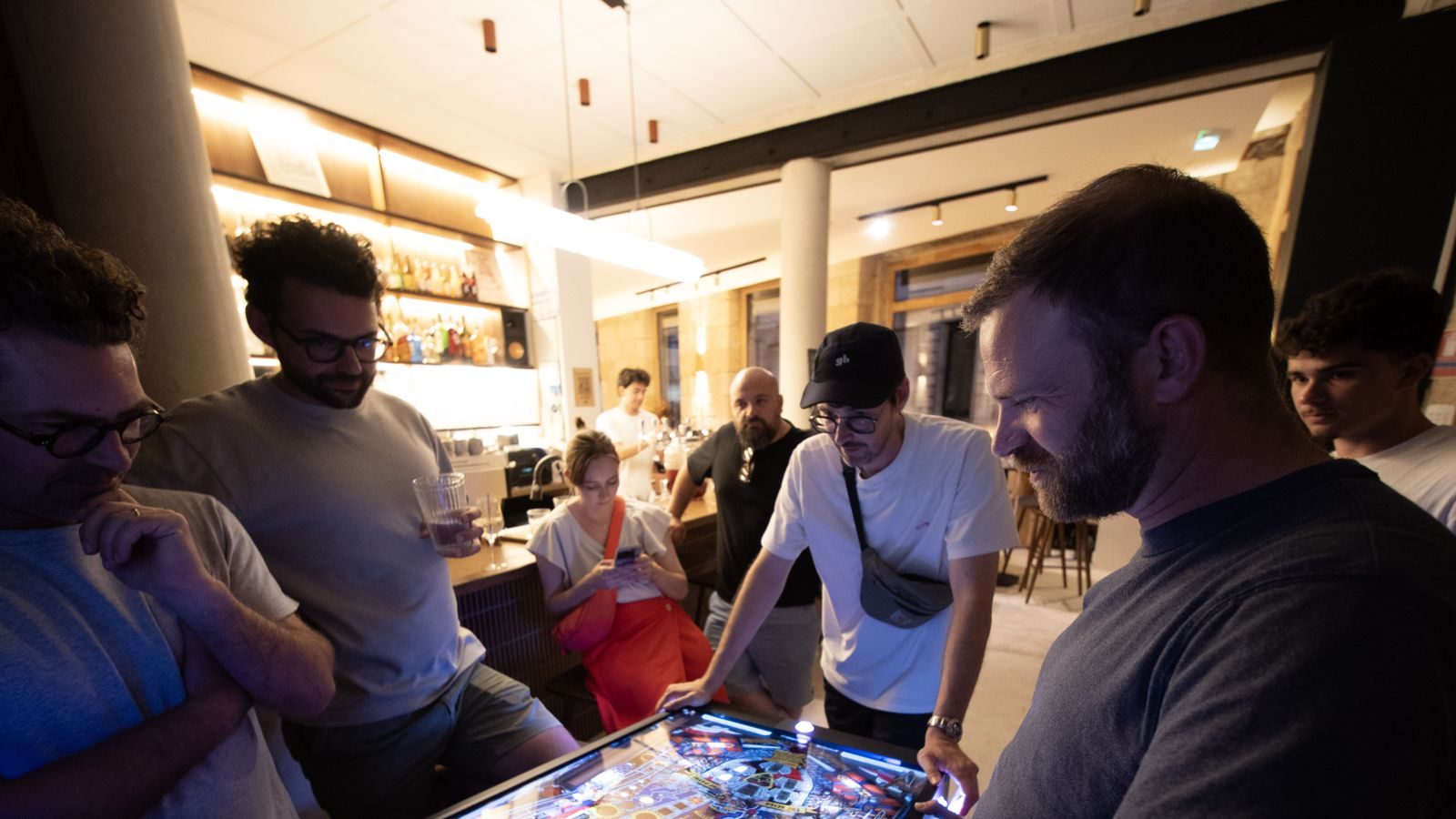
So much for the textbook definition. Now for the truth: pinball isn't retro. The way people talk about it is. A game where a steel ball is right at your fingertips, where you go head-to-head with friends, and where every single game is different is exactly what today's players are looking for. Physical, social, alive.
At BUMP, we build pinball machines. This guide pulls together everything you need to know to understand the game, pick a machine, or simply get the itch to play. And when we have an opinion, we don't hold back.
Why is pinball called “flipper”?
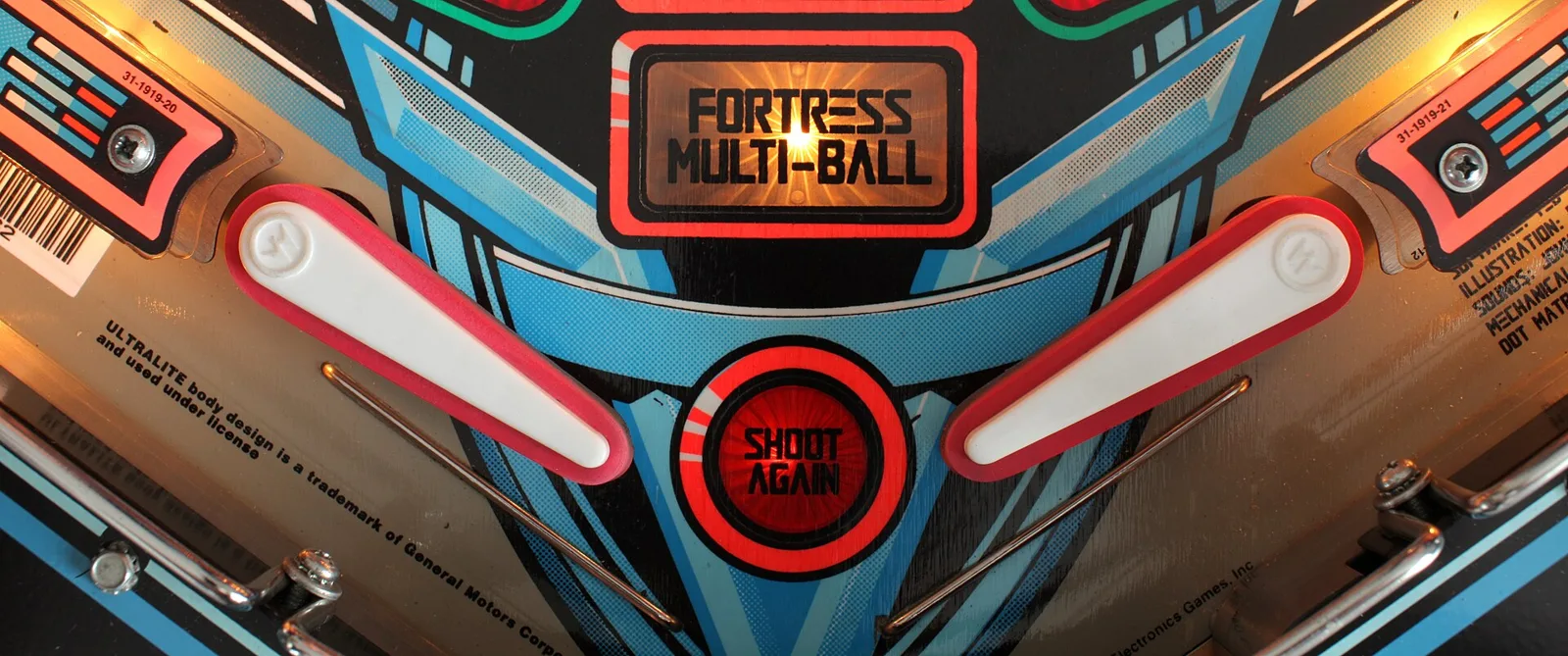
While English and Spanish speakers call the game pinball, French speakers use the word flipper to refer to the entire machine—even though it originally only designated the flippers themselves, those two bats triggered by the side buttons.
France isn't alone in this. Germany and Italy also say flipper, while the Netherlands and Flanders go with flipperkast. English and Spanish, meanwhile, stick with pinball. So when French, German, and Italian players talk about a flipper, they mean the exact same machine. Pretty handy when throwing down a challenge.
How Does a Pinball Machine Work?
A pinball machine turns gravity into gameplay. The playfield is slightly angled toward the player, the ball rolls back down on its own, and the player flips it back up with the flippers to hit point-scoring targets.
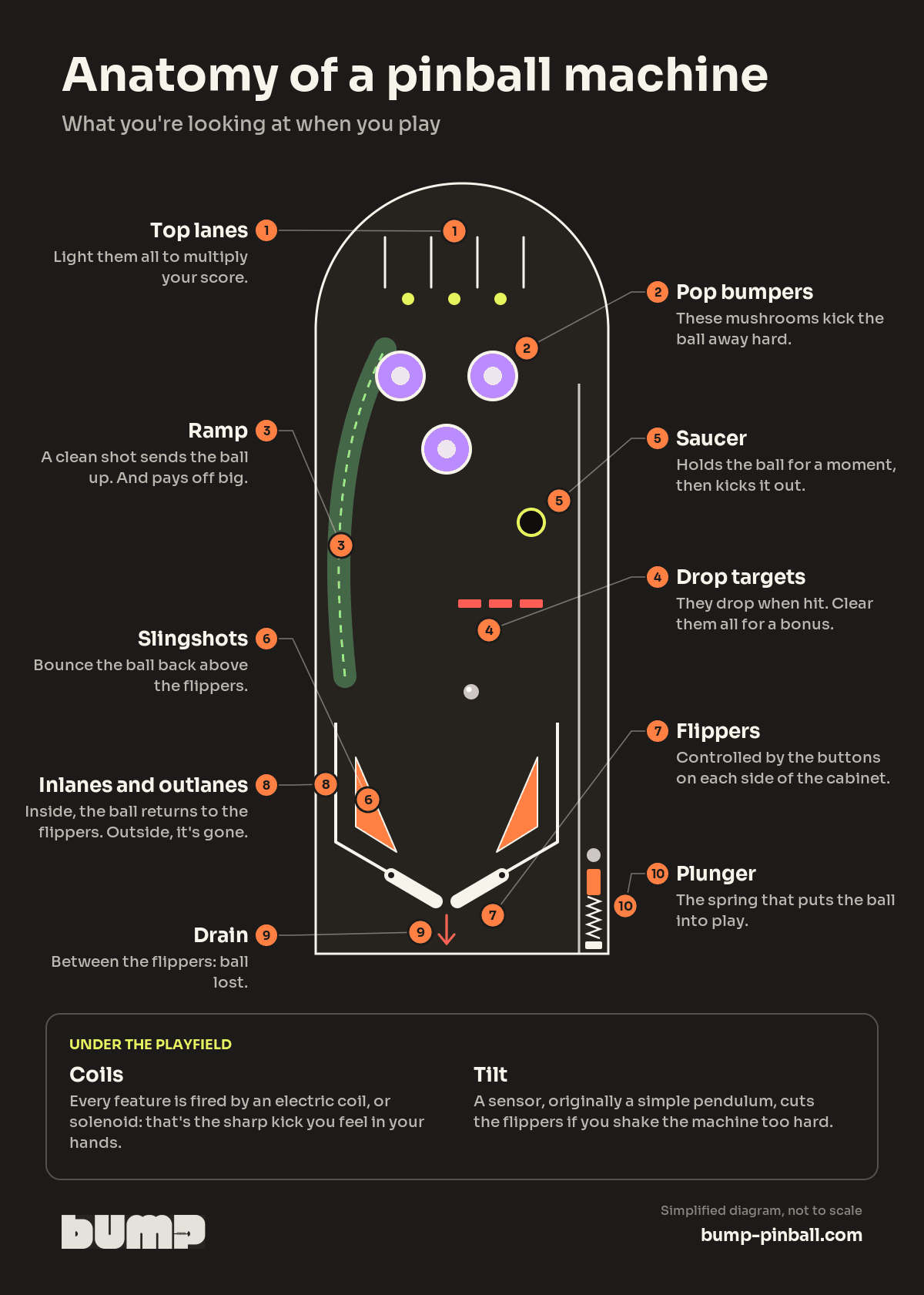
The game kicks off at the plunger, the spring-loaded shooter on the right. From there, the ball meets everything that gives a table its soul: bumpers—those mushrooms that kick it back violently—ramps, stand-up or drop targets, and scoops that hold it captive for a beat. Each mechanism is powered by an electric coil, or solenoid, delivering that crisp snap you can feel right in your hands.
The standard ball is a steel sphere measuring about 27 millimeters. If it drains between the two flippers or slips down the outlanes, it's lost. A game is typically played with three balls.
You're allowed to nudge the cabinet to rescue a ball. Just don't overdo it: a sensor, historically a simple pendulum, triggers the infamous tilt and cuts power to the flippers if you get too aggressive.
On a modern pinball machine, software orchestrates modes, missions, and multiballs. Pinball is essentially a video game with a real, physical ball: objectives, levels, and high scores to beat. That's why a great table can be played for years without ever getting stale.
On a virtual simulator, the concept is identical, but the playfield is displayed on a large flat-mounted screen and the ball physics are calculated by a physics engine. The buttons, plunger, and tilt mechanism are retained, and some models include solenoids to physically replicate the mechanical feedback. To dive deeper, see what is a pincab.
The Major Pinball Eras
There are five major pinball families, each mapping to a distinct tech generation. They stand apart chiefly in how the machine tracks points and tells the story of the game.
| Era | Period | Display | Defining Traits | Benchmark Example |
|---|---|---|---|---|
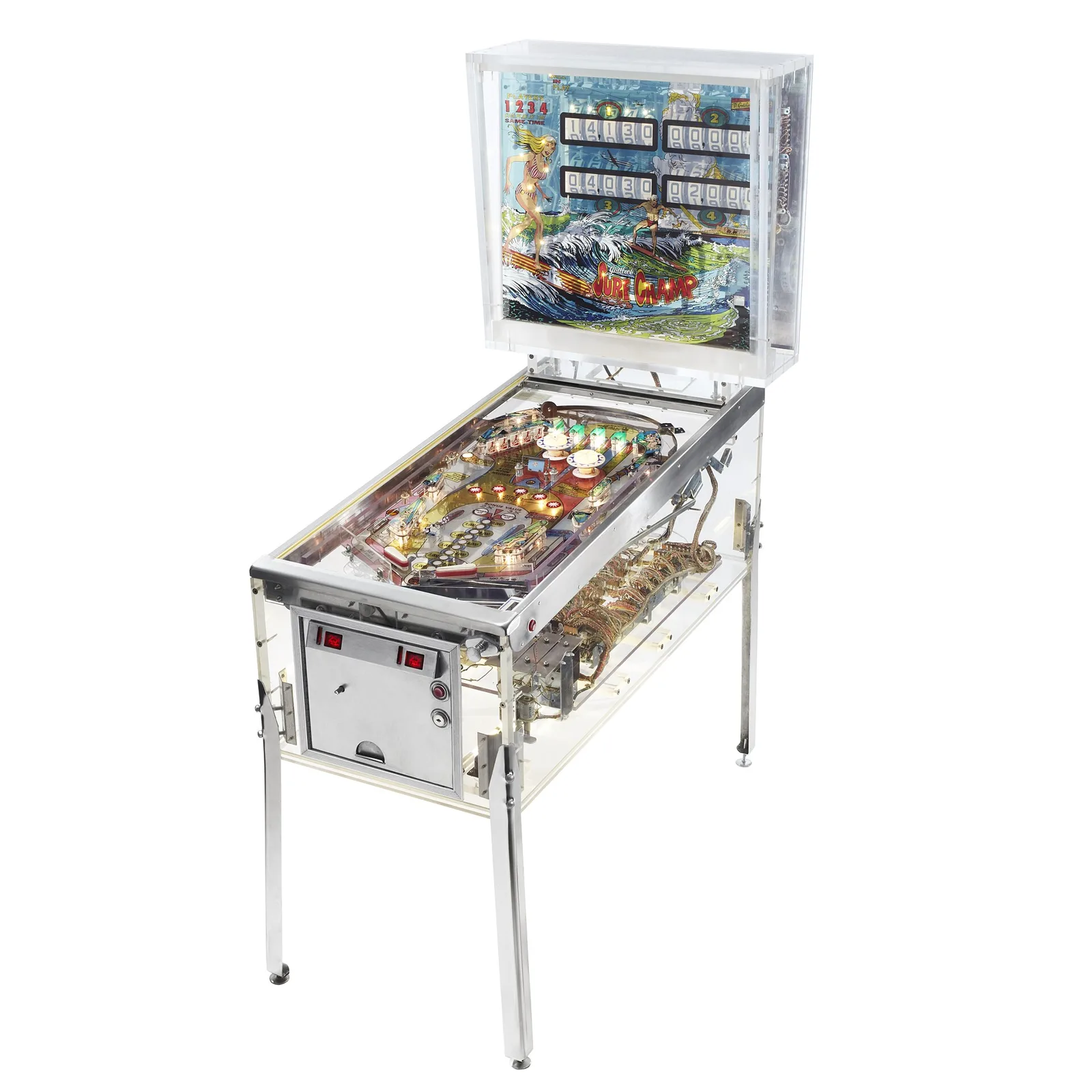
| Electromechanical (EM) | 1930s to the late 1970s | score reels | relays and motors, zero microprocessors | Humpty Dumpty, Gottlieb, 1947 |
| Early Solid-State (Segmented) | 1977 to 1991 | segmented digital displays | first microprocessors, electronic sounds | Eight Ball, Bally, 1977 |
| Dot-Matrix Solid-State | 1991 to the 2010s | dot-matrix display (DMD) | animations, modes, deep storylines | The Addams Family, Bally, 1992 |
| Modern Connected | 2010s to today | LCD screen in the backbox | software updates, online connectivity | The Wizard of Oz, Jersey Jack Pinball, 2013 |
| Simulator (Virtual Pinball, Pincab) | 2000s to today | screen playfield | simulated tables, dozens of games packed into one cabinet | Visual Pinball, 2000 |

The first four families are physical pinball machines: the ball is real steel. The fifth is a simulation. It is neither a cheap knockoff nor a second-rate substitute: it is simply another way to play the game, with its own unique perks.
Pinball Has Always Been Ahead of Its Time
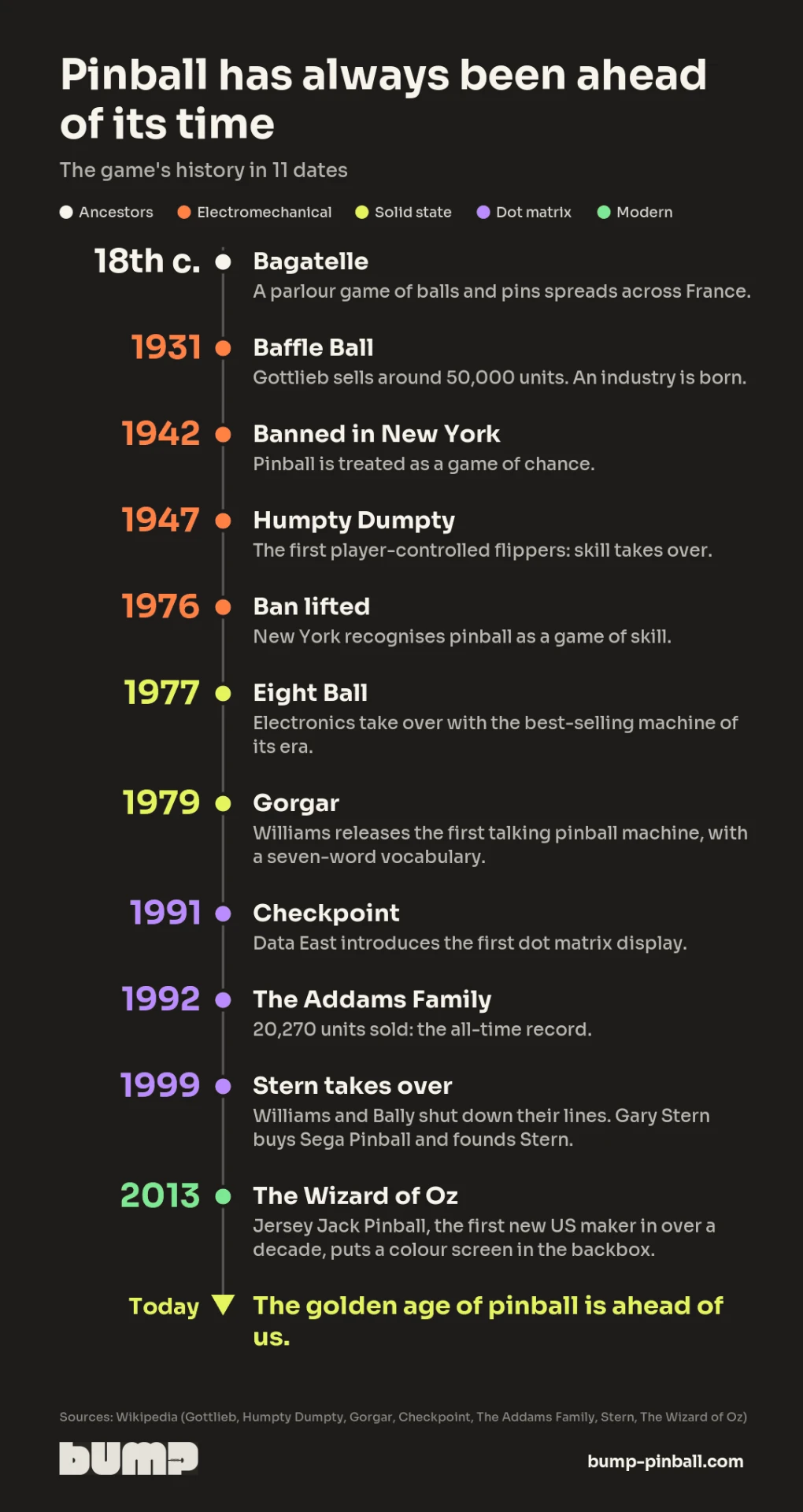
Tracing the history of pinball isn't about wallowing in nostalgia. It's about seeing how, in every era, it embraced the cutting-edge tech of the day: electricity, microprocessors, digital displays, and software.
| Year | Event | Why It Matters |
|---|---|---|
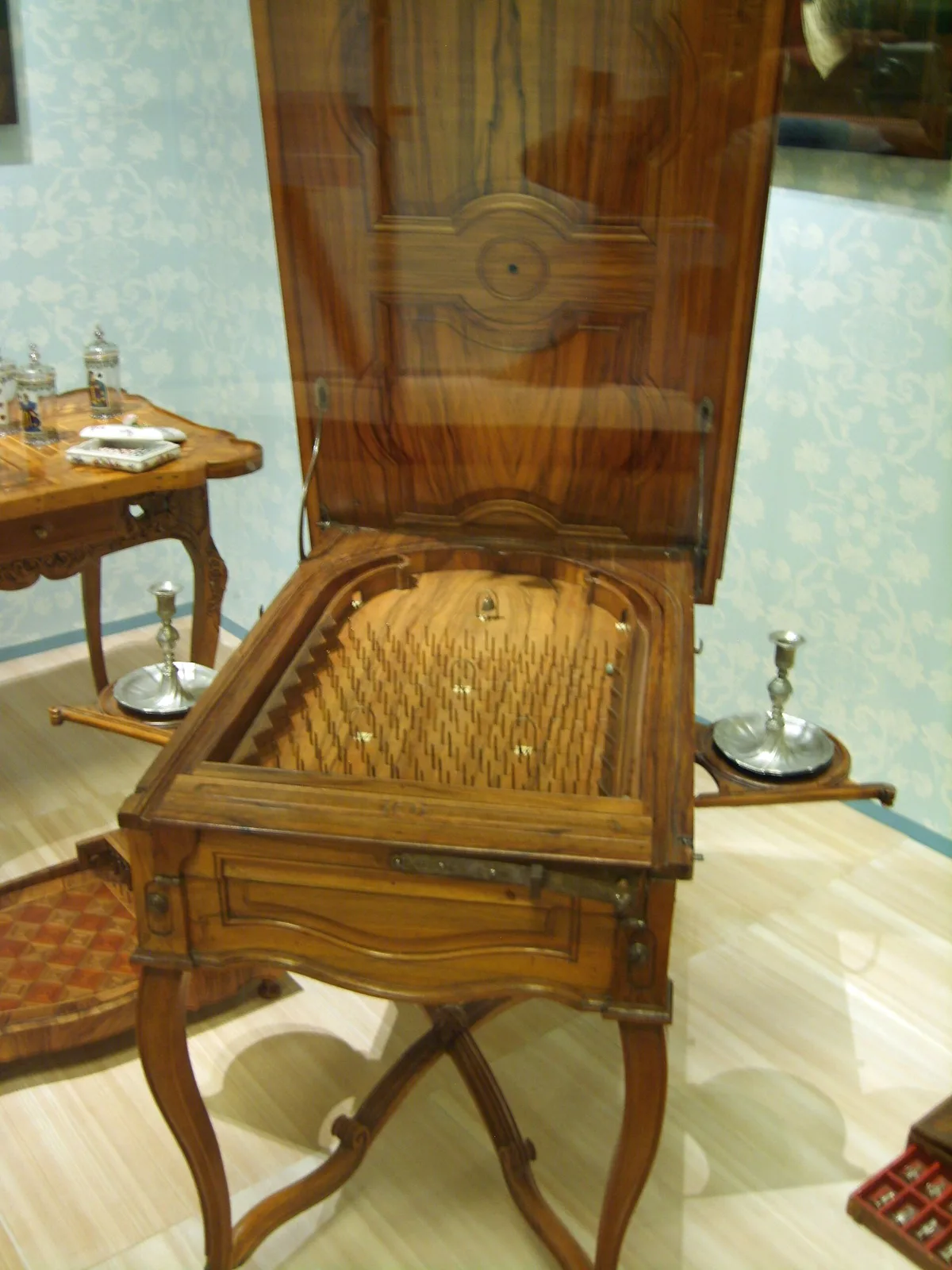
| 18th century | Bagatelle, a parlor game with balls and pins, spreads across France | Pinball's direct ancestor |
| 1931 | Gottlieb launches Baffle Ball, selling around 50,000 units at $17.50 each | Birth of the industry right in the depths of the Great Depression |
| 1942 | New York bans pinball, branding it a game of chance | The start of thirty-five years underground |
| 1947 | Gottlieb releases Humpty Dumpty, the first pinball machine with player-controlled flippers | Chance makes way for skill |
| 1976 | New York lifts the ban | Pinball is officially recognized as a game of skill |
| 1977 | Bally Eight Ball becomes the best-selling pinball machine of its era | Solid-state electronics take over |
| 1979 | Williams releases Gorgar, the first talking pinball machine, featuring a seven-word vocabulary | Audio becomes an essential part of the game |
| 1991 | Data East Checkpoint, the first pinball machine with a dot-matrix display | Pinball starts telling stories |
| 1992 | Bally The Addams Family, 20,270 units sold | The all-time sales record, still unbeaten today |
| 1999 | Williams and Bally exit pinball; Gary Stern buys Sega Pinball to found Stern | Stern becomes the last major manufacturer standing |
| 2013 | Jersey Jack Pinball releases The Wizard of Oz, featuring a full-color LCD screen in the backbox | First new American manufacturer in over a decade: modern pinball is born |
Sources: Baffle Ball and Gottlieb, Humpty Dumpty, Checkpoint, Gorgar, The Addams Family, Stern, The Wizard of Oz.
The best chapter remains the New York showdown. For thirty-five years, pinball was treated there like a slot machine. In 1976, journalist Roger Sharpe convinced the city council it was a game of skill by calling his shot—announcing exactly which lane he would send the ball into, and nailing it. A single flip, and the ban collapsed. You'd be hard-pressed to find a better demonstration that you have to play pinball to truly understand it.
For a deeper dive into its history, distributor and specialist media outlet ExtraBall published a comprehensive feature on the invention of pinball.
Why pinball clicks with gamers
Pinball is one of the original high-score games in history, long before home consoles ever existed. Everything a video gamer loves is already right there: objectives, combos, wizard modes, high-score leaderboards, and that irresistible itch to play just one more game.
That’s also why big franchises feel right at home under the glass. Pokémon, Beetlejuice, The Big Lebowski, superheroes, iconic rock bands: pop culture's heaviest hitters become pinball machines. On a great table, the theme isn't just cosmetic dressing. It becomes gameplay: you're not just watching the universe, you're playing right inside it.
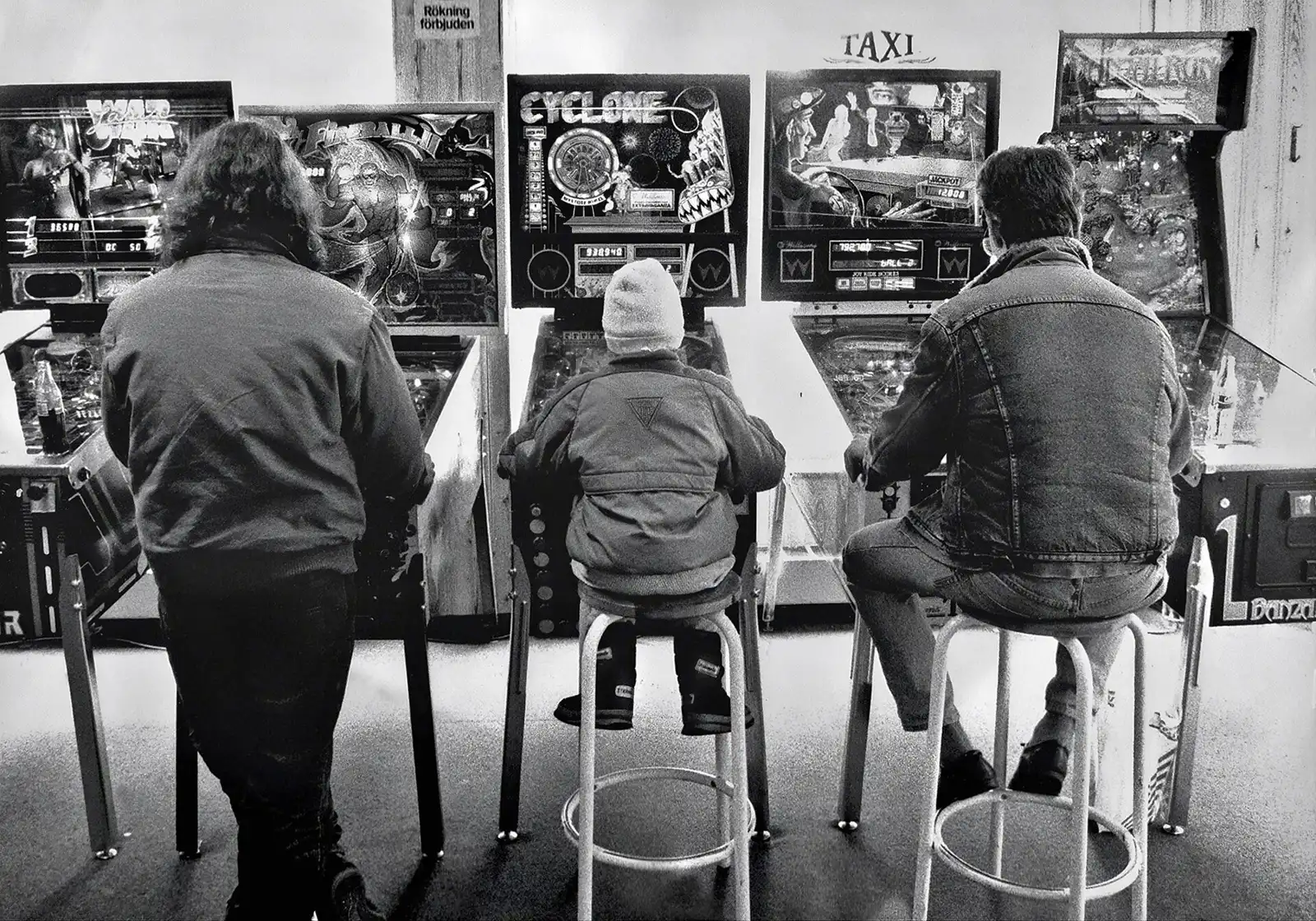
And unlike a video game, pinball is played on your feet, side by side, with someone watching over your shoulder waiting for their turn. It’s a physical, social game. Exactly what so many screens are missing today.
Who Makes Pinball Machines Today?
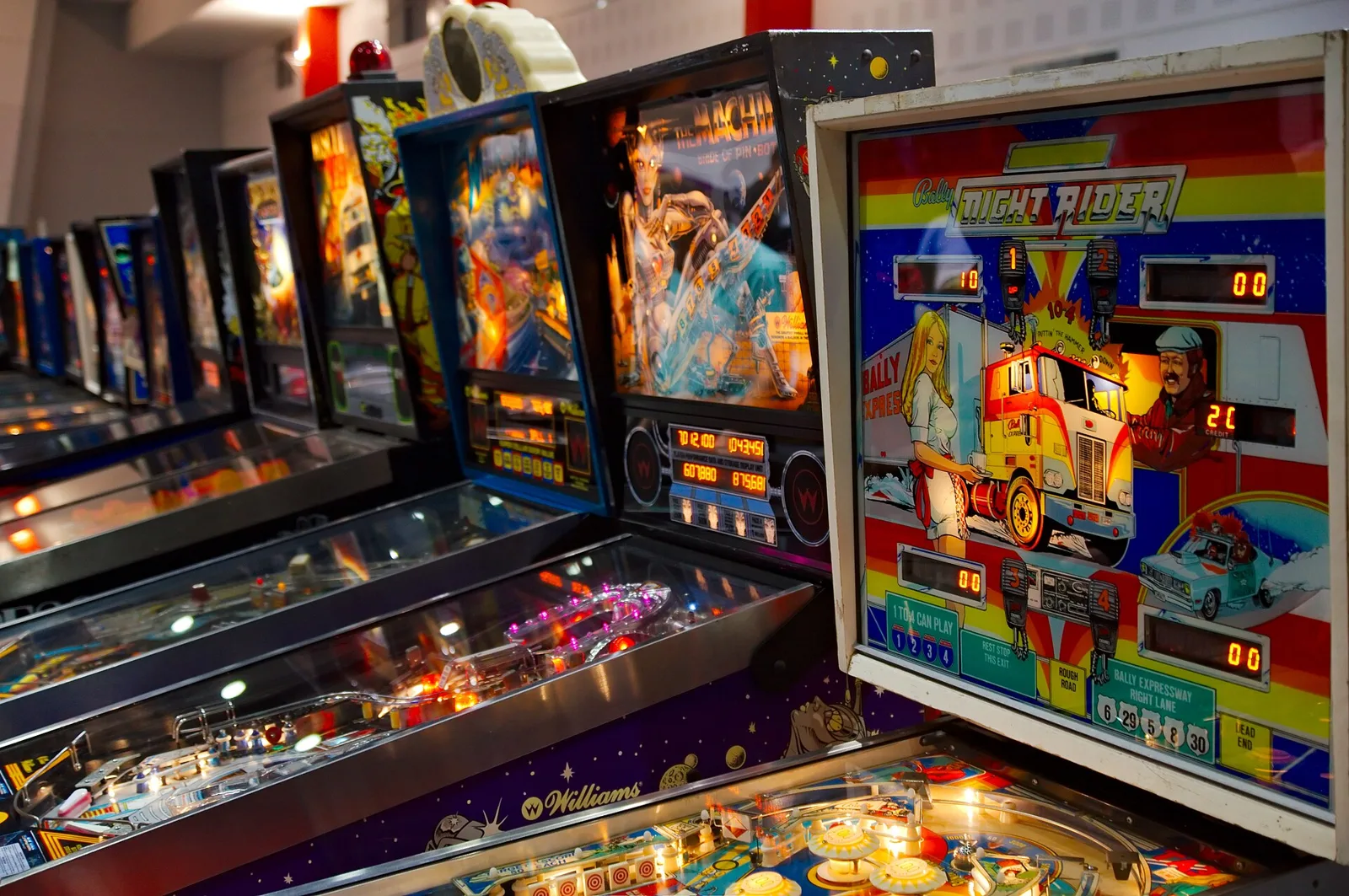
Brand-new mechanical pinball machines are made by about a dozen companies, mostly concentrated in the Chicago area, which accounts for over 90% of global production according to industry media (Good Vibes Pinball).
| Manufacturer | Country | What You Need to Know |
|---|---|---|
| Stern Pinball | United States | Market leader, drops multiple new licensed titles every year |
| Jersey Jack Pinball | United States | Premium tier, massive backbox displays |
| Chicago Gaming Company | United States | Remakes of classic 1990s hits |
| Spooky Pinball | United States | Boutique runs, 999 units planned for Beetlejuice |
| Barrels of Fun | United States | Exciting recent newcomer |
| Pinball Brothers | Sweden | European maker, movie and music licenses |
| Dutch Pinball | Netherlands | European maker, famous for The Big Lebowski |
| Pedretti Gaming | Italy | European maker |
| Hexa Pinball | France | French maker of mechanical machines, founded in 2021 near Bordeaux, with Space Hunt and The 3 Musketeers |
| Bump Pinball | France | Premium digital pinball assembled by hand in France, with 140+ licensed tables |
Sources: Good Vibes Pinball, 2026 News, Kineticist, Hexa Pinball.
On the virtual pinball side, the landscape is different. Tables are released by video game studios like Zen Studios with Pinball FX, or created by the Visual Pinball community. The cabinets themselves are assembled by custom workshops, including several in France. To compare models, check out the best digital pinball machines.
Our take: brand-new pinball hasn't been this vibrant since the 1990s. Stern picked Pokémon for its first 2026 pinball machine, Spooky keeps crafting boutique limited runs, and five European manufacturers appear in this table, two of them in France. The market may have shrunk in pure volume, but definitely not in ambition. Only one key thing is missing: themes and brands that genuinely hook players who haven't plunged a ball yet.
How Much Does a Pinball Machine Cost?
A pinball machine costs anywhere from a few thousand euros to over €25,000. The price depends first and foremost on the category: a virtual simulator starts much lower than a brand-new mechanical pinball machine, while the second-hand market spans the entire spectrum.
| Pinball Type | Price Range | What Drives the Price |
|---|---|---|
| Simulator (virtual pinball) | €2,000 to over €10,000 | screen, graphics power, build quality, licensed games |
| New mechanical | From around €8,400 incl. VAT up to €25,000 for limited editions | manufacturer, license, standard vs. limited edition |
| Used mechanical from the 1970s and 1980s | €1,000 to €4,000 in working order | condition, rarity, restoration |
| Used mechanical from the 1990s | €1,500 to €3,500 for most models | title, condition, servicing |
| Recent used mechanical | €4,000 to €8,000 | title, options, age |
Sources: High Voltage Pinball for new machines, Pinballs Store for second-hand (Dutch market, 2026). The most sought-after titles, like Medieval Madness or Monster Bash, blow right past these brackets.
Two things often take buyers by surprise. A new pinball machine under three years old typically sheds around 20% on resale—except for a handful of ultra-popular titles that skyrocket in value. And on vintage second-hand machines, the purchase price is only part of the equation: a complete overhaul can easily add to the bill.
For a complete line-by-line breakdown, check out our in-depth price guide.
Mechanical or simulator: don't pick a side
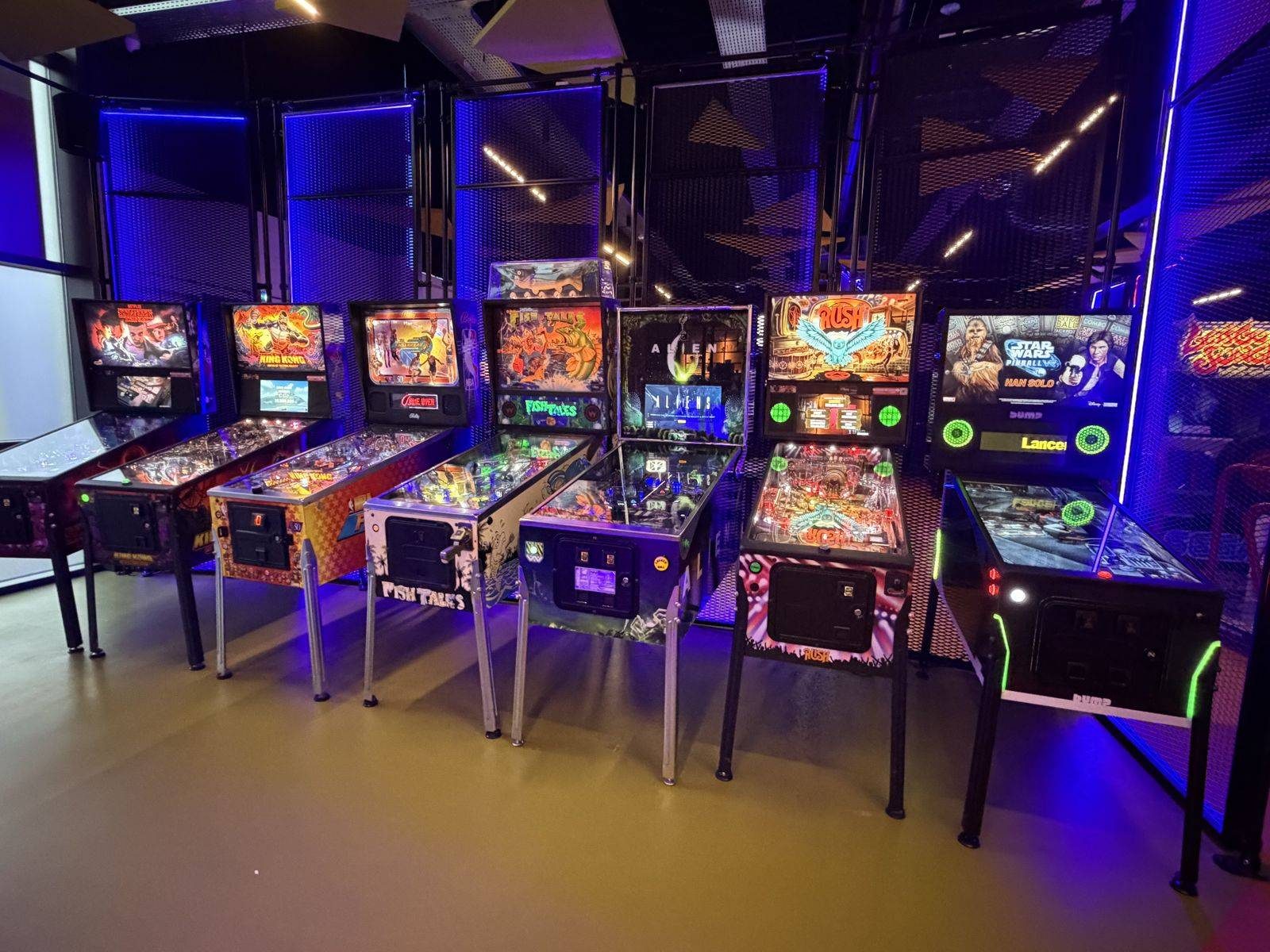
Mechanical pinball delivers maximum physical intensity on a single table. A simulator packs dozens of games into one machine, with zero mechanics to service. Both are genuine pinball. The right question isn't "which one is real," but "how do you want to play?"
| Criterion | Mechanical pinball | Simulator |
|---|---|---|
| Number of games | a single table | from several dozen to several hundred |
| Feel | real ball, real physical impacts | simulated ball, feedback varies by model |
| Maintenance | regular: rubbers, coils, playfield cleaning | no mechanical parts to maintain, software updates |
| New entry price | around €8,400 | starting around €2,000 |
| Value over time | certain titles resell well or even appreciate | tends to follow standard consumer electronics depreciation |
| Who it's for | the collector, the player dedicated to one specific table | players who crave variety, families, commercial venues |
Our take: if your heart is set on one specific table and you enjoy tinkering under the glass, go mechanical. If you want to flip on a 1990s classic on Monday and a brand-new licensed title on Tuesday—spending 100% of your time playing—get a simulator. Plenty of players end up owning both. A simulator doesn't replace pinball; it broadens the experience.
For a detailed breakdown across every criterion, check out our complete mechanical versus virtual pinball comparison.
Where to Play Pinball in France?
France boasts nearly 500 public spots loaded with pinball machines. The community database PinballBall counts 493 of them, mostly game bars, arcades, and bowling alleys (PinballBall).
| City | Listed Venues |
|---|---|
| Paris | 56 venues, 261 pinball machines |
| Lyon | 19 |
| Bordeaux | 18 |
| Lille | 16 |
| Rennes | 15 |
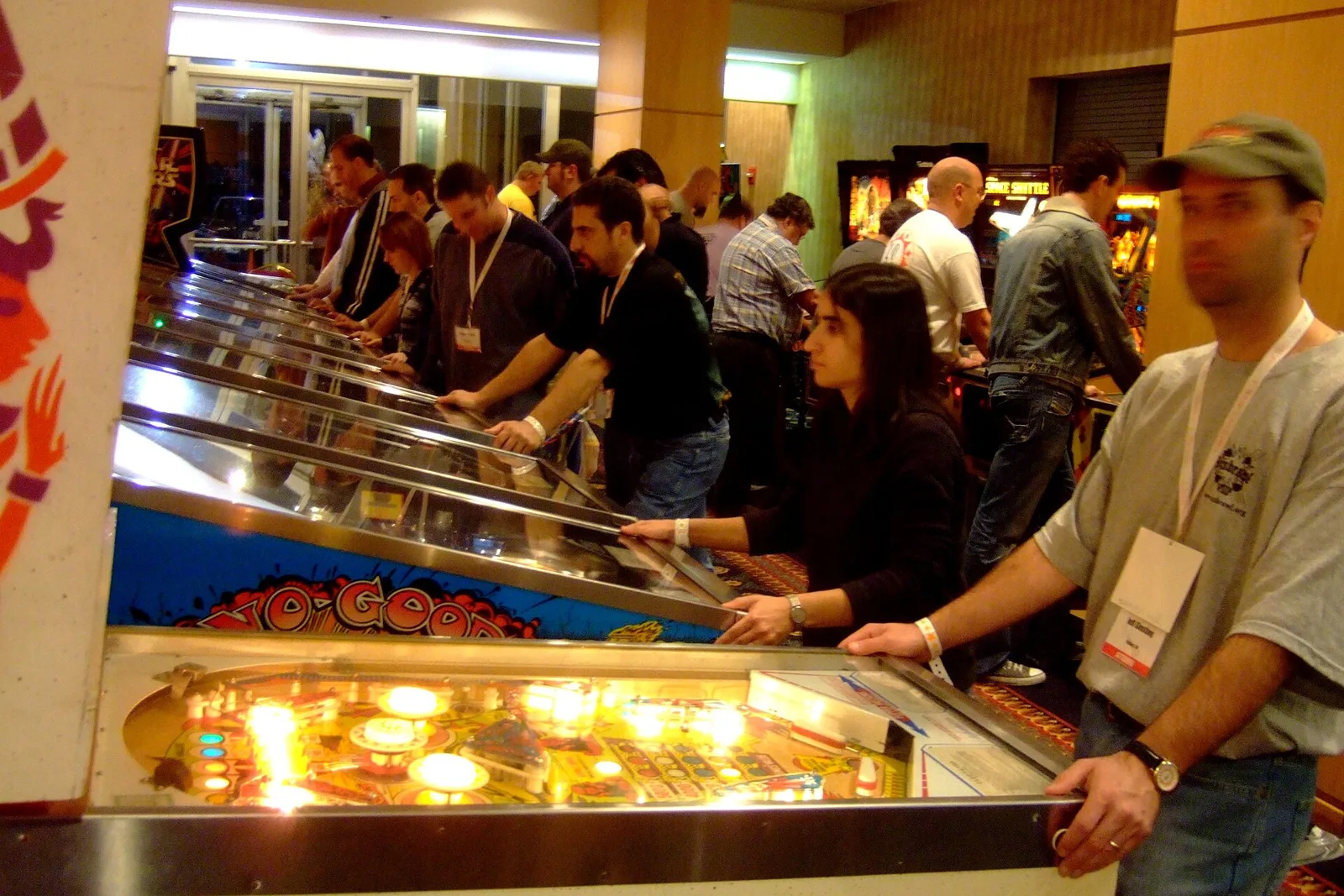
Three main types of spots rule the landscape. Board game bars, which exploded across the country in the 2010s, often feature several modern pinball machines. Arcades lean heavily on 1980s and 1990s classics. Lastly, museums and dedicated enthusiast clubs open their private collections to the public, such as the Musée historique du flipper in Paris.
To hunt down a machine near you, the community-driven Pinball Map app is the ultimate go-to. And if you're looking to put a top-tier digital pinball simulator through its paces, you can always drop by and take a BUMP for a spin.
Never Played Before? Where to Start
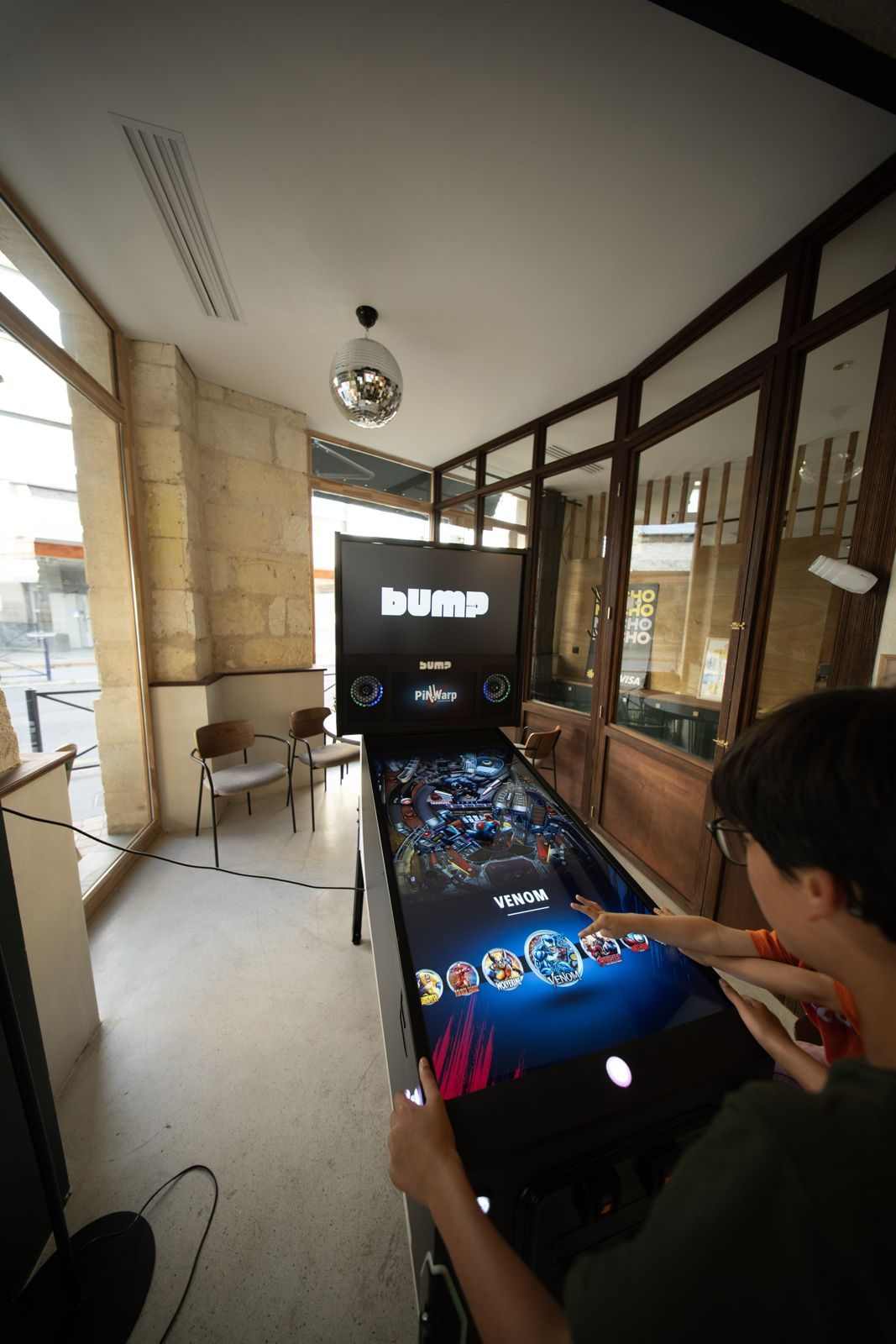
Good news: you're exactly who pinball was made for. There's nothing to study before you play, and that's the whole point.
Three tips for your first few games. Don't flip at random: cradle the ball on a raised flipper, take aim, then shoot. Keep your eyes on the ball, not the flippers. And don't walk away from the table after just three games: around game ten is when you really start to understand what it wants from you.
The rest comes with playing. Pinball is hard to explain, but clicks right away—from the very first ball.
Owning a pinball machine at home: what to plan for
A pinball machine at home mainly takes space, a power outlet, and enough clearance to get it through the door. The rest is simply a matter of taste.
A standard-sized pinball machine measures roughly 75 centimeters wide by 1.40 meters long, with the backbox standing nearly 2 meters tall. Plan for some room to play, plus extra breathing room for spectators. Most machines partially disassemble—backbox and legs—to fit through doors or navigate staircases.
Noise is often underestimated: a mechanical pinball machine is a loud beast, firing coils and all. A digital pinball simulator, on the other hand, lets you turn the volume down.
Finally, consider how much you will actually play it. A pinball machine definitely brings character to a room, but a machine left untouched is just an oversized piece of furniture. Pick titles that keep you coming back for one more game. For layout and decor tips, see integrating a pinball machine into your living room.
The golden age of pinball is ahead of us
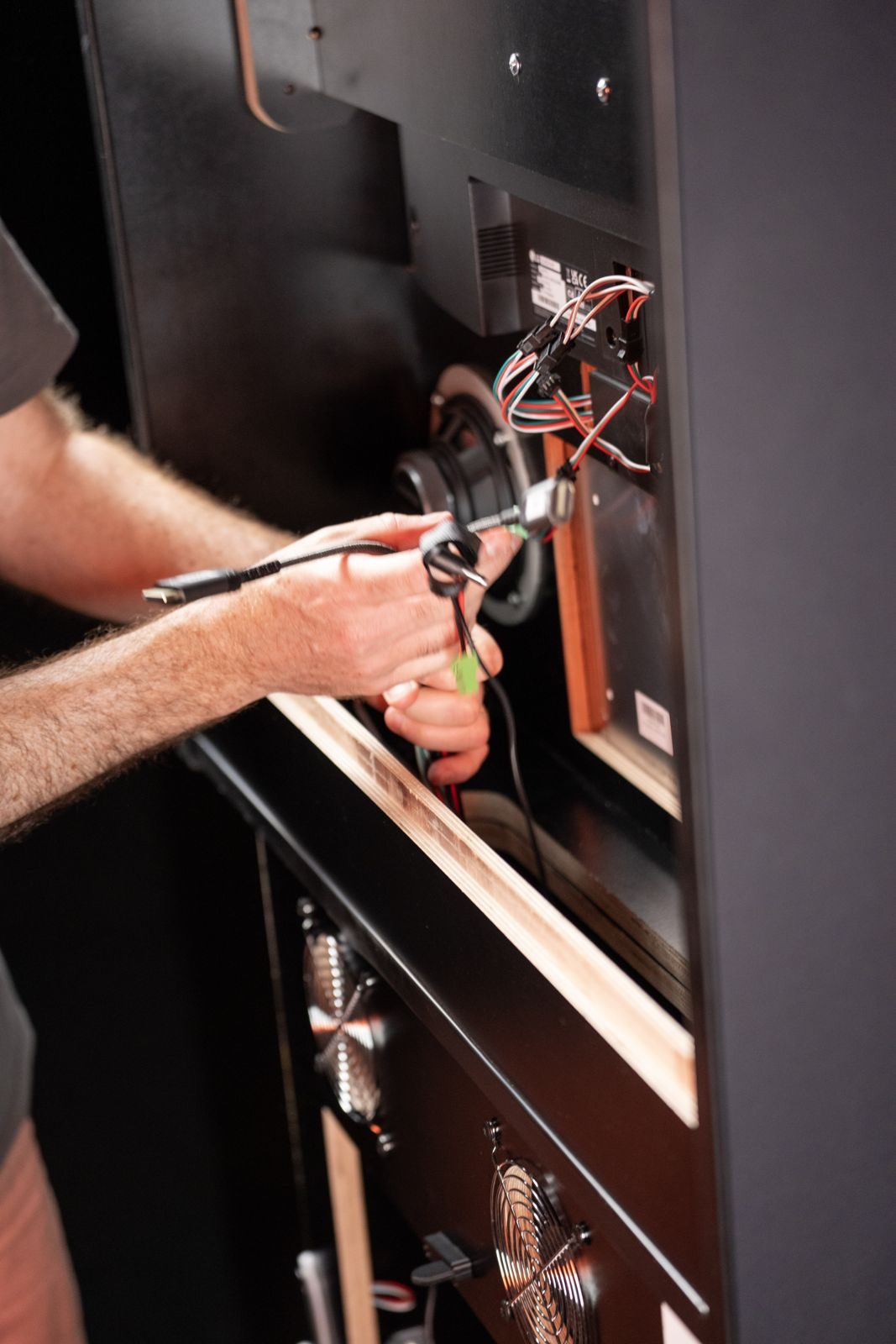
We don't build pinball machines just to preserve nostalgia. We build them because we believe the future of gaming isn't strictly digital: it's also tactile, social, and vibrantly alive.
That's why we created BUMP. Our simulator packs over 140 games under a single glass, onto a 4K OLED panel powered by an RTX 5070 graphics card, hand-assembled in France. And that's just the beginning: we're also working on mechanical pinball with Bump #001.
To really get it, nothing beats flipping for real. Give it a shot, or start by discovering BUMP.
FAQ
What is the difference between pinball and a flipper?
None, it's the exact same game! While English and Spanish call it pinball, French, German, and Italian refer to the whole game as a flipper. In English, the word flipper only refers to the bats used to hit the ball.
Who invented pinball?
Pinball descends from bagatelle, an 18th-century French parlor game. The first commercially successful machine was Baffle Ball, launched by Gottlieb in 1931. Player-controlled flippers made their debut in 1947 with Humpty Dumpty, also produced by Gottlieb.
What is the best-selling pinball machine in history?
The Addams Family, released by Bally in 1992, with 20,270 units sold. It edged out the previous record holder, Bally's Eight Ball, which had held the top spot since 1977, by just 40 units.
How much does a new pinball machine cost?
A brand-new mechanical pinball machine starts around €8,400 including tax, climbing up to €25,000 for certain limited editions. A new virtual pinball machine ranges from €2,000 to over €10,000 depending on the screen, computing power, and build quality.
Is pinball a game of chance?
No, it's a game of skill. It was long considered a game of chance, to the point of being banned in New York from 1942 to 1976. Ever since flippers were introduced in 1947, the player actively controls the ball's trajectory.
Is a virtual pinball machine a real pinball machine?
In principle, yes: you have the sloped playfield, flippers, plunger, and tilt sensor. The difference is that the ball and playfield are simulated on a screen. A virtual pinball machine serves up dozens of games with zero mechanical maintenance, while a real mechanical machine delivers authentic physical feedback on a single table.
Do pinball machines require maintenance?
A mechanical pinball machine needs regular maintenance: cleaning the playfield, swapping out rubber rings, and inspecting coils. A virtual pinball machine has virtually no mechanical parts to service, just software updates.
How much room do you need for a pinball machine at home?
Plan on roughly 75 centimeters wide, 1.40 meters long, and nearly 2 meters high, plus a bit of room behind it to play comfortably. The backbox and legs typically come off to fit through doorways.
Where can I play pinball near me?
France is home to about 500 pinball venues, including 56 in Paris. Community apps like Pinball Map or the PinballBall database let you quickly locate the nearest bars, arcades, and museums.
In summary
Pinball is a game of skill born in the 1930s, available today in both mechanical and simulator formats. A brand-new mechanical table starts around 8,400 euros for a single machine, while a simulator packs dozens starting at 2,000 euros. Neither is more authentic than the other: they are simply two ways to play the same game. And this game is anything but retro. To make your choice, start with our detailed price guide.